

Key Takeaways
- An Explanation of Benefits is a summary from your insurer, not a bill you must pay immediately.
- Each EOB shows the billed amount, the insurer's allowed amount, and what you owe after adjustments.
- Errors on EOBs are more common than most people expect and can inflate your out-of-pocket costs.
- You have the right to appeal a claim decision if coverage was denied or incorrectly applied.
- Comparing your EOB against the provider's bill helps catch duplicate charges and coding mistakes.
What you will need
What an EOB actually is
An Explanation of Benefits (EOB) is a statement your health insurer mails or posts to your online account after processing a claim. It is not a bill. It tells you what your provider charged, what your insurer agreed to pay, and what portion the insurer expects you to cover based on your plan terms.
Insurers are generally required to send an EOB for every processed claim, whether the claim was paid, partially paid, or denied. Because families with regular medical care can receive dozens of EOBs per year, many people file them unread. That habit can be costly. A billing error or a wrongly denied claim will appear on the EOB long before a collection notice ever arrives.
If you want to understand costs before a visit rather than after, the cost-awareness checklist walks through questions to ask about network status and billing in advance.
The anatomy of an EOB, field by field
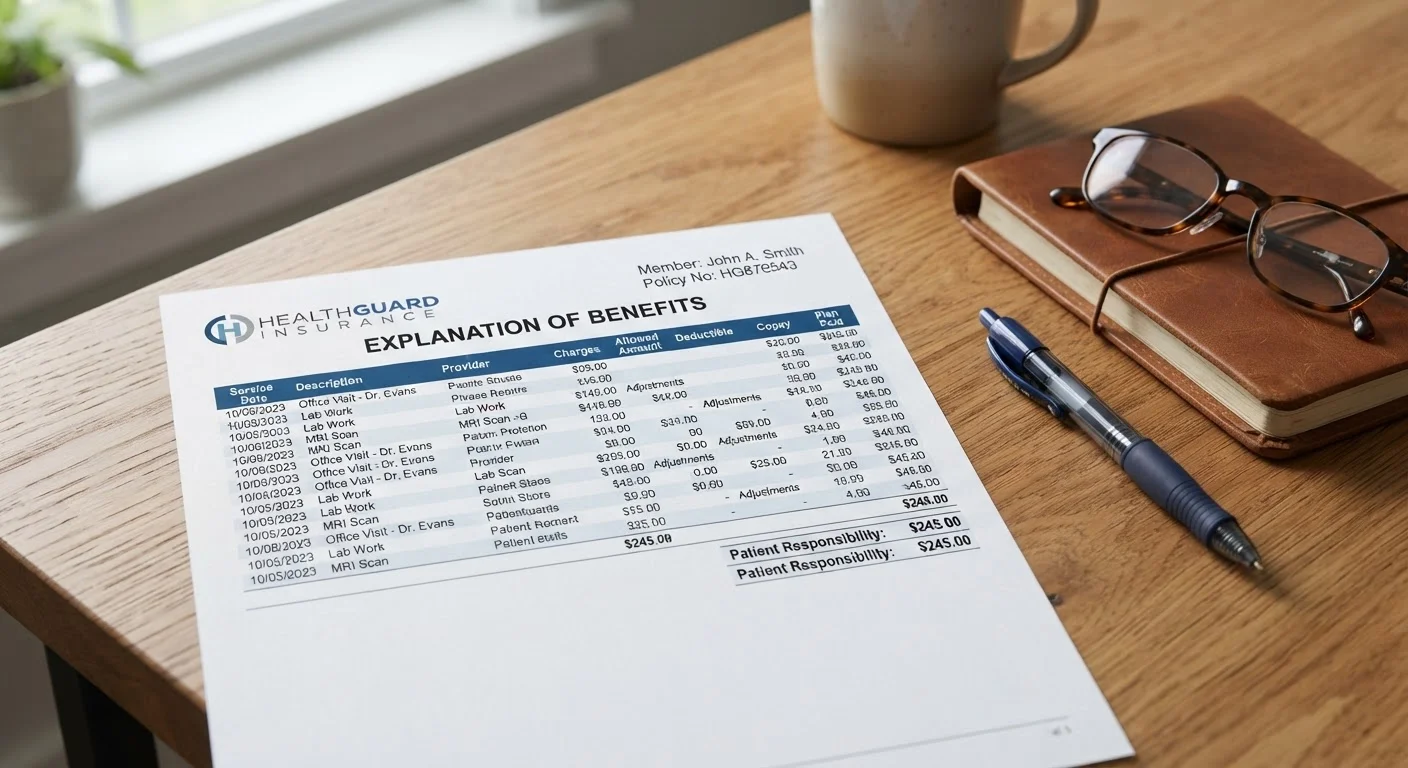
EOB layouts differ by insurer, but every document contains the same core fields. Here is what each one means:
- Billed amount: What the provider charged before any adjustments. This number is often far above what the insurer actually pays.
- Allowed amount (also called negotiated rate): The rate your insurer has contracted with in-network providers to accept as full payment. The difference between billed and allowed is written off by the provider.
- Plan paid: The dollar amount your insurer paid toward the allowed amount after applying your deductible, copay, or coinsurance rules.
- Deductible applied: Any portion of the allowed amount counted toward your annual deductible. Once your deductible is met, this column should read zero.
- Coinsurance / copay: Your share of the allowed amount after the deductible. A 20% coinsurance on a $200 allowed amount means you owe $40.
- Patient responsibility: The total you owe the provider. This is the figure that should match any bill the provider sends you.
- Reason codes: Short codes or brief text explaining why a claim was adjusted or denied. A list of code definitions is usually printed on the back of the EOB or available on the insurer's website.
Out-of-network claims follow the same structure, but the allowed amount may be lower and the patient responsibility higher. If a bill arrives from an unexpected out-of-network provider, the No Surprises Act overview explains what federal protections may apply.
Save every EOB for at least one year
Keep EOBs until you have met your deductible and confirmed your out-of-pocket maximum has been correctly tracked by the insurer. If you switch insurers mid-year or change jobs, having a paper trail of what was applied to your deductible can prevent disputes about carry-over balances. Digital copies stored in a single folder are easier to retrieve than physical mail.
Common errors to look for
The Medical Billing Advocates of America has estimated that a significant share of medical bills contain errors, though exact figures vary by study. Common problems include:
- Duplicate line items for the same service on the same date
- Incorrect procedure codes (for example, a more complex code billed in place of a routine one)
- Services listed as out-of-network when the provider is actually in-network
- A deductible applied twice because of a data entry error
- Denied claims where the service should have been covered under preventive care rules
To check for these, pull up the provider's itemized bill alongside the EOB and match every line. If a charge appears on the bill but not the EOB, or if the patient responsibility on the EOB is higher than what the bill shows, contact the insurer's member services line before paying anything.
Preventive care denials are worth particular attention. Under the Affordable Care Act, many in-network preventive services must be covered at no cost to the patient. If your EOB shows a patient responsibility for a covered preventive visit, a coding error is a likely cause. The article on annual physicals covers what should be billed as preventive versus diagnostic.
How to dispute a problem
Gather the documents
Collect the EOB, the provider's itemized bill, and your insurance card (which shows your deductible, copay, and out-of-pocket maximum). If you do not have an itemized bill, call the provider's billing department and request one. A summary bill is not enough to verify individual charges.
Match line items between the EOB and the bill
Go line by line. Each service on the provider's bill should appear on the EOB with a matching date, procedure code, and allowed amount. Note any discrepancies in a simple list: what the bill says versus what the EOB says. This list becomes your reference for any call you make.
Decode any denial or adjustment reason codes
Find the reason code for any denied or reduced line item. The insurer's website or the back of the EOB should list definitions. Common codes include CO-4 (incorrect procedure code), CO-97 (service included in another billed service), and PR-1 (deductible). Write down the full description so you can reference it when you call.
Contact the insurer or provider to correct errors
For billing errors (wrong code, duplicate charge, network status mistake), call the provider's billing department first. They can often resubmit the claim with a corrected code at no cost to you. For coverage decisions you disagree with, call your insurer's member services line and ask for an explanation of the denial. Document every call: date, representative name, and what was said.
File an appeal if the denial stands
Every insurer must have an internal appeals process under the Affordable Care Act. The EOB or the denial letter will state your appeal deadline, which is typically 180 days from the date of the denial notice. Submit your appeal in writing and include the EOB, any supporting clinical notes from your provider, and a clear statement of why you believe coverage should apply. If the internal appeal fails, you can request an external review by an independent organization.
If the bill is correct but unaffordable, negotiate
Once you have confirmed the patient responsibility figure is accurate, paying it in full on the spot is not your only option. Many hospitals and large practices have financial assistance programs, prompt-pay discounts, or zero-interest payment plans. The guide to negotiating medical bills covers how to ask for and document those arrangements.
This article provides general health and financial information only. It is not medical or legal advice. Consult a qualified professional for decisions specific to your situation.