

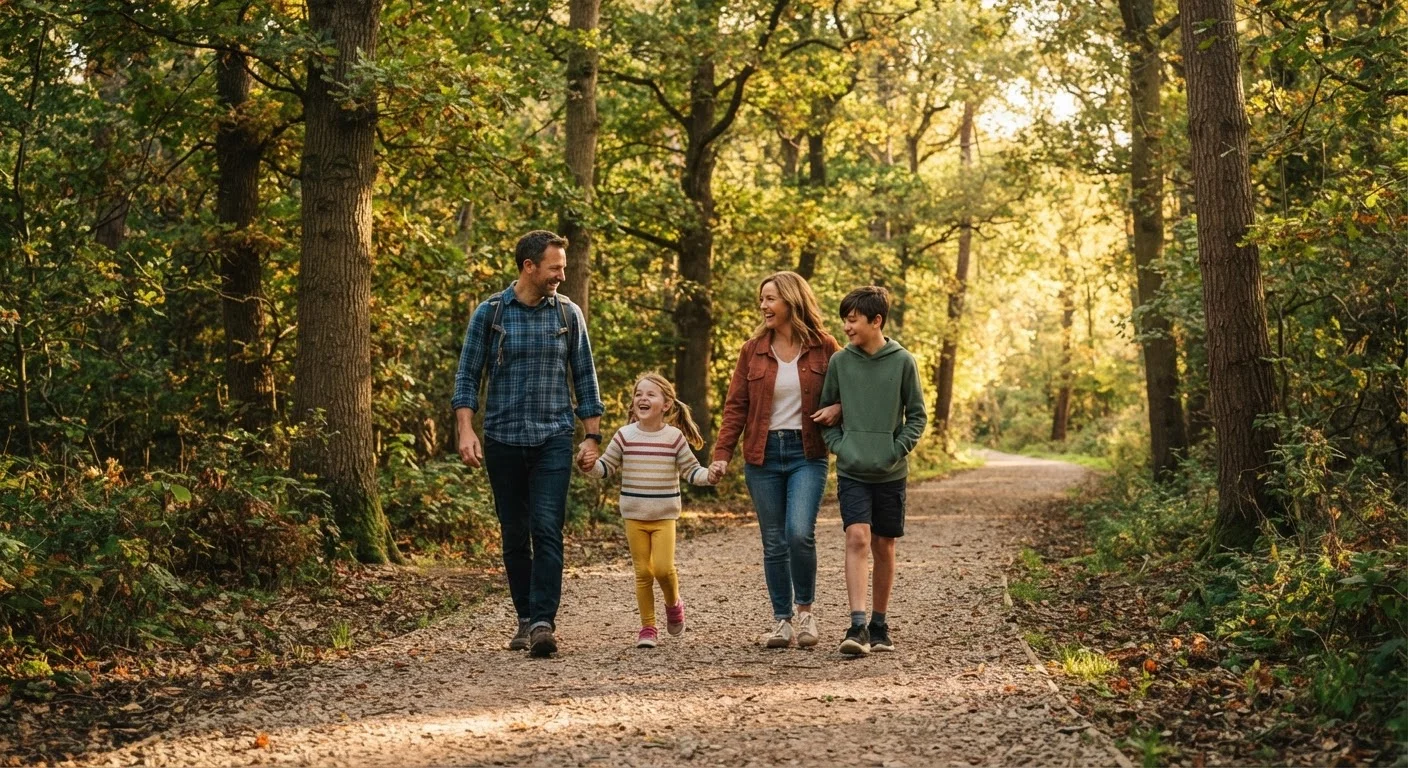
Key Takeaways
- Children who move regularly outdoors are more likely to stay active into adulthood.
- Parents' own activity levels are one of the strongest predictors of children's physical habits.
- Outdoor activity does not require paid programs or equipment to be effective.
- Short, consistent movement sessions build stronger long-term habits than occasional intense efforts.
- Pairing outdoor time with existing daily routines lowers the barrier to starting.
Why early movement habits matter more than fitness levels
Physical fitness in childhood is useful, but it is not the main reason early activity matters. What children learn in their first decade is whether movement is enjoyable, normal, and worth doing. That orientation toward physical activity, formed long before organized sports or gym memberships enter the picture, is what predicts adult behavior more reliably than athletic ability alone.
Public health guidance from the U.S. Department of Health and Human Services recommends that children aged 6 to 17 get at least 60 minutes of moderate to vigorous physical activity each day. For adults, the recommendation is 150 minutes of moderate activity per week. Families who move together tend to meet these targets more consistently than those who rely on children's programs alone.
The connection between parent behavior and child behavior is direct. When parents are physically active, children in the same household are more likely to be active. This holds across income levels and neighborhood types. It means that family activity is both a health strategy and a modeling opportunity, and outdoor settings tend to be the most accessible arena for both. See our ideas for free family fitness activities for neighborhood-specific options that cost nothing.
Building habits that hold without spending money
The most durable family movement habits share one trait: they do not depend on paid programs, equipment, or memberships. When financial circumstances change, habits tied to those resources tend to disappear. Habits built around free public space and existing routines survive.
Outdoor activity is particularly well-suited to low-cost habit building. Sidewalks, parks, schoolyards, and green spaces exist in most American neighborhoods, and they are available without scheduling or fees. The fitness on a budget hub covers a range of strategies for keeping the family active across different seasons and budget situations.
Consistency matters more than intensity. Families who move outdoors for short periods most days build stronger long-term patterns than those who push hard on weekends and sit all week. This is not a matter of opinion: behavioral research on habit formation consistently shows that frequency and environmental cues are better predictors of lasting behavior than motivation or effort alone.
A note on special health situations
Children with chronic conditions, mobility differences, or developmental considerations may need individualized guidance on physical activity. Parents in these situations should consult a pediatrician or physical therapist before establishing new activity routines. General public health recommendations are not a substitute for personalized medical advice.
Recommended practices for families
Make outdoor movement part of an existing daily anchor, not a separate event.
When activity is attached to something the family already does, such as walking to school or spending time outside after dinner, it requires less willpower to maintain. Habits built around existing cues are more durable than those that depend on scheduling extra time.
Let children observe parents and caregivers moving outdoors regularly.
Research in child development consistently shows that children model the behaviors they witness at home. A parent who walks, bikes, or plays outside sends a signal that physical activity is a normal part of adult life. This social learning shapes expectations that persist into adolescence.
Prioritize unstructured outdoor play for children under 12.
Unstructured play outdoors builds motor skills, spatial awareness, and the intrinsic motivation to move for enjoyment. When activity always comes from organized sports or adult-directed exercise, children may not develop the self-driven desire to move that carries habits into adulthood.
Choose free or low-cost outdoor venues rather than paid programs as the baseline.
Families who tie physical activity to a paid gym or structured program are more likely to stop when finances tighten. Building habits around free public spaces, such as parks, trails, and schoolyards, makes activity resilient to budget changes.
Vary the activity to hold interest across different ages in the same household.
A six-year-old and a fourteen-year-old have different fitness levels, coordination, and social interests. Finding activities that can be adapted across ages, such as biking at different paces or playing informal ball games, keeps every family member engaged rather than sidelining the youngest or oldest.
For families working around packed schedules, fitting health habits into daily routines covers how to integrate movement alongside other preventive care priorities without overhauling your week.
What to do when weather, season, or schedule disrupts the routine
Outdoor activity is not always possible, and treating a disruption as a failure makes it more likely that the habit breaks entirely. The goal is to recover the routine quickly, not to maintain a perfect record.
When weather is the barrier, comparing outdoor and indoor free exercise can help families find an indoor substitute that keeps momentum going. When schedules compress, even a 10-minute walk maintains the behavioral cue better than skipping entirely.
For families finding it hard to stay consistent over months, research-informed strategies for maintaining exercise routines addresses the specific obstacles that come with budget and time pressure. Planning a weekly schedule in advance, rather than deciding day by day, reduces the friction that leads to skipped sessions. The step-by-step guide to building a weekly exercise plan walks through how to do that without paid classes or equipment.
This article is for general informational purposes only and does not constitute medical advice. Consult a qualified healthcare professional before making changes to your family's physical activity routine, particularly for children or adults with existing health conditions.