

Key Takeaways
- Gym memberships carry recurring costs that add up significantly over a year for a family.
- Home workouts can be highly effective without purchasing any equipment.
- Convenience and schedule fit matter as much as equipment access for long-term consistency.
- Neither option guarantees results; adherence over time is what drives fitness progress.
- Many families do well with a hybrid approach that costs little to nothing.
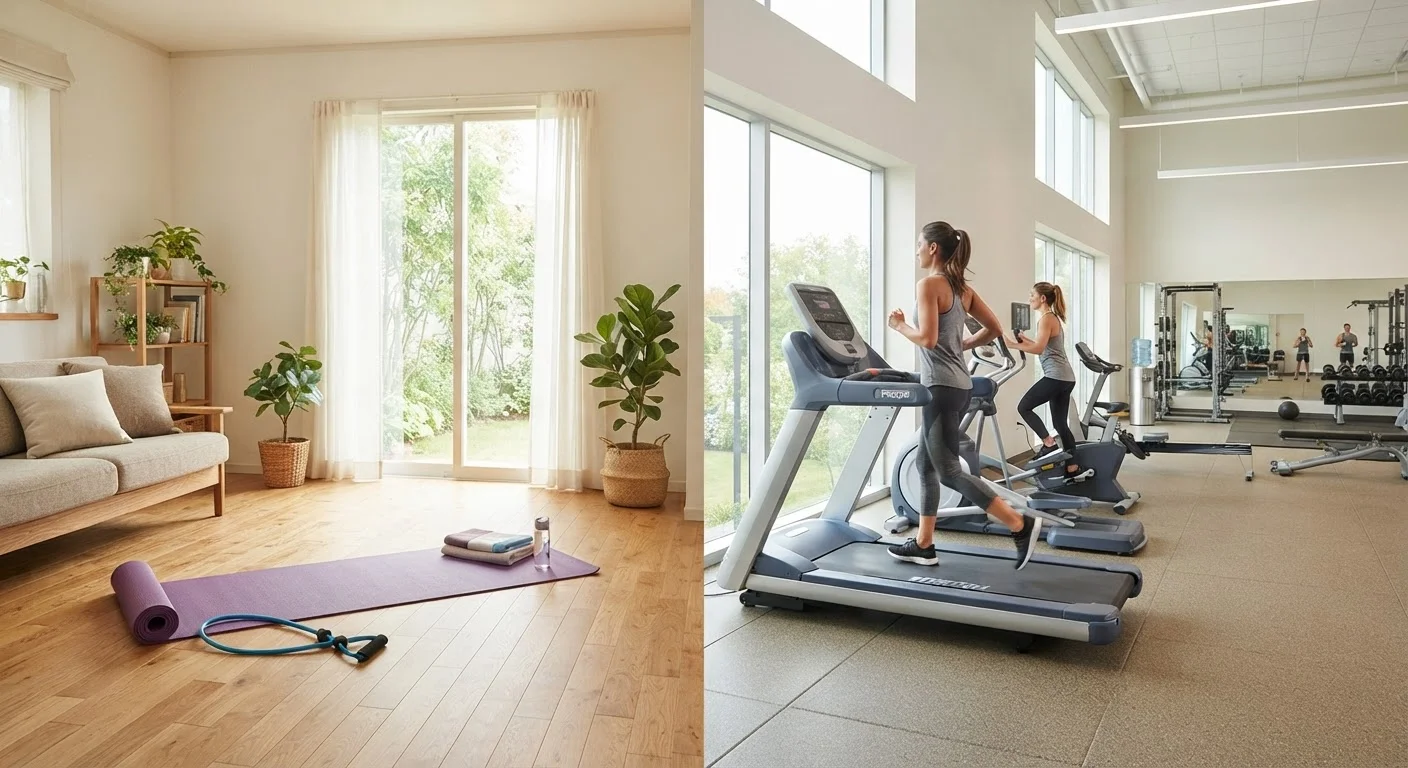
Option A
Gym membership
The structured, equipment-rich option.
Best for: Individuals or families who want access to a wide range of equipment, group classes, or accountability that a dedicated fitness space provides.
Option B
Working out at home
The flexible, low-cost alternative.
Best for: Families who need to fit exercise around unpredictable schedules and want to avoid recurring monthly fees.
If your household budget is tight and every dollar counts
Working out at home
Bodyweight routines, free video resources, and outdoor spaces cost nothing recurring. The savings over a year are substantial for a family of three or more.
If you need specialized equipment or supervised training
Gym membership
Weight racks, pools, and certified trainers are difficult to replicate at home. A gym fills that gap if those tools are genuinely part of your plan.
If schedule unpredictability makes fixed commitments hard
Working out at home
Home workouts have no travel time and no closing hours. That flexibility makes it easier to stay consistent when family life is irregular.
If motivation drops without social structure or classes
Gym membership
Group fitness classes and a shared environment can help some people stay accountable when solo exercise is hard to sustain.
If you want to involve young children in physical activity
Working out at home
Home and outdoor workouts let the whole family participate together without childcare logistics or age restrictions. See our family fitness ideas for inspiration.
What you actually pay with each option
A single gym membership in the United States commonly runs between $30 and $60 per month for a basic facility, based on widely reported industry averages. For a family of four, that figure multiplies fast. Annual family gym costs can reach $1,500 or more before factoring in enrollment fees, childcare add-ons, or premium class passes. Some facilities charge a one-time enrollment fee on top of the monthly rate.
Home workouts, by contrast, carry no mandatory recurring cost. Free workout videos are available through public libraries, community websites, and platforms with ad-supported tiers. A yoga mat and a set of resistance bands are the only purchases most beginners actually need, and neither requires significant spending. For families already watching the budget, this difference is not marginal. For more on how fitness spending myths can skew decisions, see common fitness misconceptions examined.
| Criterion | Gym membership | Home workout |
|---|---|---|
| Typical monthly cost (individual) | $30 to $60+ | $0 to minimal |
| Typical annual cost (family of 4) | $1,200 to $2,500+ | $0 to $100 (equipment) |
| Equipment access | Extensive (weights, machines, pool) | Limited to what you own |
| Schedule flexibility | Tied to facility hours | Any time, no travel |
| Child-friendly | Varies; childcare often extra | Yes, whole family can join |
| Social or class options | Group classes available | Free online classes only |
| Space required | None at home | Small clear area needed |
| Contract commitment | Often 12-month contract | None |
Convenience, time, and the logistics gap
Travel time is a real cost. A gym that takes 20 minutes to reach each way adds nearly seven hours of transit per month for someone going four times a week. For parents managing school pickups, work shifts, or shared transportation, that overhead narrows the realistic window for exercise considerably.
Home workouts eliminate that gap entirely. A 30-minute session can happen at 6 a.m. before anyone else is awake, or at 9 p.m. after the kids are in bed. There are no parking lots, no locker room queues, and no closing times. Building a weekly routine around a family schedule becomes more realistic when the workout space is already inside the house.
Gyms do offer something home spaces often cannot: a clear physical separation between exercise and daily life. Some people concentrate better when they leave home to work out. That psychological separation has real value for certain individuals, even if it is hard to assign a dollar figure to it.
$58
Average monthly gym membership cost in the U.S.
Reported by Statista based on consumer spending surveys across major fitness facility categories.
67%
Gym members who rarely or never use their membership
A frequently cited statistic in consumer behavior research on fitness spending habits.
20+ min
Average one-way travel time to a commercial gym
Based on self-reported commute data in fitness consumer surveys across suburban and urban areas.
What the research says about effectiveness
Exercise science consistently shows that the type of setting matters far less than the consistency of effort over time. Bodyweight training, when done regularly and with appropriate intensity, produces measurable improvements in strength, cardiovascular fitness, and mobility. The American College of Sports Medicine and similar professional bodies publish guidelines that reference activity type and duration, not facility type.
That said, progressive overload, the principle of gradually increasing the challenge to the body, is easier to manage with access to a range of weights and machines. For someone pursuing specific strength or body composition goals, a gym's equipment selection provides more room to advance without purchasing additional gear at home.
For families focused on general health and staying active together, consistency matters more than setting. A routine that actually gets done repeatedly beats a superior program that gets skipped.
When a hybrid approach makes sense
Many families find a middle path that costs little. A combination of home bodyweight sessions, outdoor activity, and occasional use of a low-cost community facility covers most fitness needs without a full gym membership. Community recreation centers run by local governments often charge significantly less than commercial gyms and include pool access, group classes, and childcare.
For outdoor options, outdoor versus indoor exercise is worth reviewing if weather and space are factors in your household. Parks, trails, and open spaces are free and available year-round in most parts of the country.
Before committing to a gym contract, it is worth examining whether the specific equipment or classes at that facility are genuinely part of your plan, or whether the appeal is more general. A contract signed on motivation alone often gets canceled within a few months. For broader perspective on managing health-related spending, the Managing Health Costs hub covers practical strategies across healthcare categories.
This article is for informational purposes only and does not constitute medical or financial advice. Consult a qualified healthcare professional before beginning any new exercise program, particularly if you have existing health conditions.