

Key Takeaways
- Bodyweight training costs nothing and can be done anywhere with no equipment.
- It builds genuine strength and endurance, not just light conditioning.
- Progressive overload is possible without weights by adjusting leverage, tempo, and movement complexity.
- Families can participate together regardless of fitness level.
- Research supports bodyweight exercise as effective for general fitness goals.
Bodyweight training
Bodyweight training is a form of exercise that uses your own body as the only source of resistance. Push-ups, squats, lunges, and planks are common examples. No weights, machines, or gym membership are required. You can do it in a living room, backyard, park, or hotel room.
In exercise science, bodyweight movements are classified as calisthenics. They can target muscular strength, muscular endurance, flexibility, and cardiovascular fitness depending on how they are structured.
What bodyweight training actually means
Bodyweight training is exercise where your own mass provides the resistance. There is no barbell, cable machine, or resistance band involved. Your muscles work against gravity and leverage using the weight of your limbs and torso.
The category covers a wide range of movements: pushing (push-ups, dips), pulling (pull-ups, rows using a low bar or table), squatting (air squats, jump squats), hinging (glute bridges, single-leg deadlifts), and core stabilization (planks, hollow holds). Cardio-focused movements like jumping jacks, mountain climbers, and burpees also fall within this category.
What makes it distinct is the absence of cost. You do not need a gym, a weight set, or a subscription. The floor beneath you and the space around you are the only requirements. That is why bodyweight training is the foundation that starting a home workout routine with no equipment is built on.
How it builds strength without added weight
A common misconception is that bodyweight exercise only produces light conditioning, not real strength. The mechanism of strength development is progressive overload, meaning your muscles are asked to do more over time than they currently find comfortable. You can achieve that without ever touching a weight plate.
With bodyweight training, you manipulate difficulty through several variables. Changing the leverage, for example moving from a two-arm push-up to an archer push-up to a one-arm push-up, dramatically increases load on the working muscles. Slowing down the lowering phase of a movement, called a tempo change, increases time under tension. Reducing your base of support, such as doing a single-leg squat instead of a double-leg squat, adds instability and neuromuscular demand.
These adjustments mean the ceiling for difficulty is high. Advanced gymnastic movements like the planche or front lever require exceptional upper-body strength that many weight-trained athletes cannot replicate. Most people will never need to reach those levels, but the point stands: bodyweight training is not limited to beginners.
Start with movement quality, not quantity
Before adding reps or harder progressions, focus on doing each movement through its full range of motion with control. A slow, controlled squat to full depth builds more usable strength than 30 partial-range reps done quickly. Form also reduces the risk of common overuse injuries when you increase volume later.
Why the cost is genuinely zero
Gym memberships, personal training, and home equipment carry real financial costs. A gym membership can run from $20 to over $60 per month, and a set of adjustable dumbbells can cost well over $200 at many retailers. For families managing tight budgets, those numbers add up fast.
Bodyweight training eliminates every one of those costs. Public parks often include pull-up bars and parallel bars through outdoor fitness installations. Playgrounds have horizontal bars suitable for rows and pull-ups. A staircase adds incline variation for push-ups and step-up exercises. None of these require a fee.
The comparison between gym and home options involves more than just cost. If you want a fuller picture of what you give up and what you gain, the real tradeoffs between gym and home training covers both sides honestly. For many families, the zero-cost option is also the more sustainable one.
$0
Equipment cost to start bodyweight training
Unlike free weights or machine-based programs, bodyweight training has no required equipment purchases or ongoing membership fees.
2+ days/week
Muscle-strengthening activity recommended for adults
The U.S. Department of Health and Human Services Physical Activity Guidelines for Americans recommend adults perform muscle-strengthening activities involving all major muscle groups at least two days per week.
~$420/year
Average annual U.S. gym membership cost
The International Health, Racquet and Sportsclub Association has reported average monthly gym membership fees in the U.S. of roughly $35, adding up to approximately $420 per year before initiation fees.
Making it work for the whole family
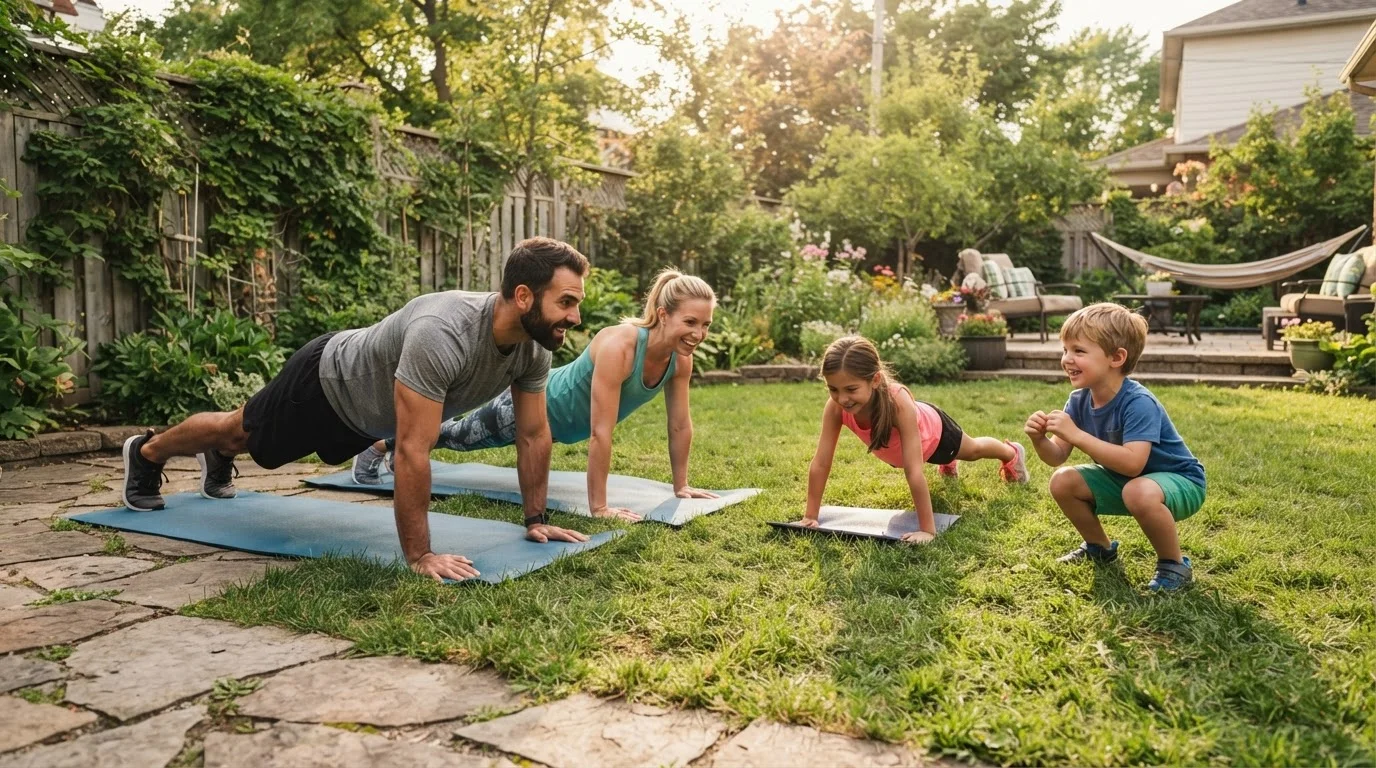
One practical advantage of bodyweight training is that multiple people at different fitness levels can exercise in the same session without separate equipment or space. A parent doing full push-ups and a child doing knee push-ups are performing the same fundamental movement pattern, just at different difficulty levels. That shared structure makes it easier to build a family habit.
Consistency over time matters more than intensity in any single session. What actually helps families stay consistent when money is tight includes keeping workouts short, predictable, and tied to an existing daily routine. Bodyweight training fits that model because there is no travel time, no setup, and no cost barrier on any given day.
If you are new to exercise altogether or unsure where to start, a healthcare professional or certified fitness professional can help you find a safe starting point, especially if you have existing health conditions or physical limitations. General information like this article is not a substitute for guidance tailored to your individual situation.
This article is for general informational purposes only and does not constitute medical or fitness advice. Consult a qualified healthcare or fitness professional before beginning any new exercise program.