
Whole Grains on a Budget: Oats, Brown Rice, Barley, and What Sets Them Apart

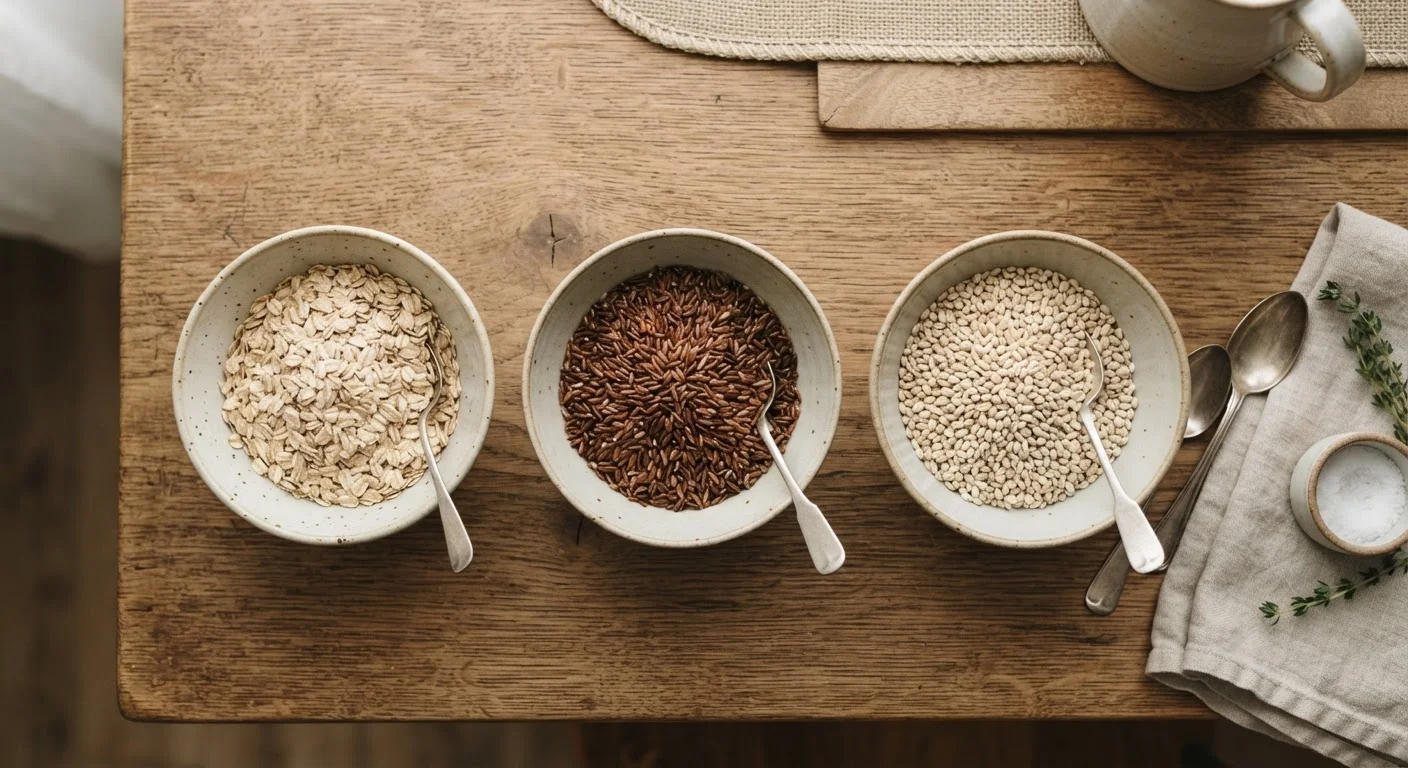
Key Takeaways
- All three grains cost well under $2 per pound in bulk or store-brand form, making them accessible staples.
- Oats have the highest protein and beta-glucan fiber content of the three, supporting satiety and heart health.
- Brown rice cooks faster than barley and is the most versatile grain for savory meals across many cuisines.
- Barley has the lowest glycemic impact and the highest total fiber of the three, but requires the longest cook time.
- Buying whole grains in bulk dry form is consistently more economical than instant or pre-seasoned varieties.
Our Verdict
Oats, brown rice, and barley each earn a place in a budget-conscious pantry. No single grain outperforms the others across every dimension. The practical approach is to stock all three and rotate based on the meal.
| Best for | Recommended |
|---|---|
| Families focused on quick weeknight meals | Brown rice |
| Those prioritizing fiber and blood sugar management | Barley |
| Budget shoppers wanting the most protein per serving | Oats |
| Households new to whole grains seeking maximum flexibility | Brown rice |
Why whole grains are worth the pantry space
Whole grains retain the bran and germ layers that refining removes. Those layers carry fiber, B vitamins, magnesium, and iron. The USDA's Dietary Guidelines for Americans recommend that at least half of all grains consumed be whole grains, and for most households, oats, brown rice, and barley are the most practical way to meet that target without straining the grocery budget.
All three are shelf-stable for months when stored in airtight containers, which means they function as genuine pantry insurance. Buying them as plain dry grains (rather than instant packets or flavored blends) cuts the cost substantially and keeps sodium and added ingredients out of the equation. For more on getting the most nutrition from a limited budget, see practical guidance on budget-conscious eating.
Comparing oats, brown rice, and barley
Each grain has a distinct nutritional profile, cost point, and cooking behavior. The table below summarizes how they compare across the factors that matter most for family meal planning.
| Oats (rolled) | Brown rice | Pearl barley | |
|---|---|---|---|
| Approx. cost per dry lb | $1.00-$1.50 | $1.00-$1.75 | $1.00-$1.50 |
| Protein per cooked cup | ~6g | ~5g | ~4g |
| Fiber per cooked cup | ~4g | ~3g | ~6g |
| Active cook time | 5 min (rolled) | 40-50 min | 25-35 min |
| Glycemic index (approx.) | Moderate (55) | Moderate (50-55) | Low (25-30) |
| Best use cases | Breakfast, baking, soups | Savory bowls, stir-fries | Soups, stews, grain salads |
| Flavor profile | Mild, slightly nutty | Mild, neutral | Earthy, chewy |
A few points from the data are worth calling out. Barley's fiber content is notably high because it contains beta-glucan throughout the grain rather than only in the outer bran layer, meaning even pearled barley (which has some bran removed) retains substantial soluble fiber. Oats also contain beta-glucan, a specific type of soluble fiber that the FDA has recognized as supportive of heart health when consumed at 3 grams per day as part of a low-saturated-fat diet. Brown rice has less fiber than the other two, but it stands out for its mild flavor and compatibility with a wide range of dishes.
On cost, all three grains are among the most economical foods per serving in the grocery store. Store-brand or bulk-bin purchases consistently deliver the lowest unit price. Comparing nutrition per dollar across food groups puts these grains in strong company alongside legumes and frozen vegetables.
Cooking times and practical trade-offs
Cook time is often the deciding factor for weeknight use. Rolled oats take about 5 minutes on the stovetop. Quick-cooking or steel-cut oats vary (steel-cut takes closer to 30 minutes), but rolled oats are fast enough for mornings or last-minute additions to soups. Brown rice runs 40 to 50 minutes for standard long-grain varieties; a rice cooker or batch cooking on weekends removes that friction. Hulled barley takes 45 to 60 minutes, and pearl barley runs 25 to 35 minutes. Because barley absorbs water and expands significantly, a batch cooked on Sunday works well portioned into meals through the week.
Overnight preparation can sidestep the time barrier entirely. Oats soaked overnight in water or milk need no cooking at all. Barley can be simmered in a large batch and refrigerated for up to five days. Brown rice freezes well in portioned containers.
Batch cook once, eat several times
Cooking a large pot of brown rice or barley at the start of the week costs the same as a single serving but saves time on four or five subsequent meals. Store cooked grains in sealed containers in the refrigerator for up to five days, or freeze in one-cup portions for longer storage. Oats soaked overnight in a sealed jar need no additional cooking and are ready when you open the refrigerator in the morning.
Pairing any of these grains with legumes rounds out the amino acid profile of a plant-heavy meal. Beans, lentils, and dried peas complement whole grains both nutritionally and in terms of cost per serving.
Where each grain fits in a weekly meal plan
Oats work beyond breakfast. Rolled oats can be stirred into meatloaf or veggie burgers as a binder, blended into smoothies for added fiber, or used as a coating for baked proteins. Their mild flavor makes them easy to incorporate without changing the character of a dish.
Brown rice is the most adaptable grain for savory meals. It holds up in stir-fries, grain bowls, stuffed peppers, and soups without becoming mushy, which matters when feeding children who are sensitive to texture. It also pairs with almost any protein or vegetable without competing for flavor.
Barley has the most assertive texture of the three: slightly chewy, with an earthy quality that suits soups and stews particularly well. Beef and vegetable barley soup is a traditional preparation for good reason; the grain absorbs broth flavor and thickens the liquid as it cooks. Barley also works cold in grain salads, though its chewiness requires some getting used to for family members new to whole grains.
For a broader look at stocking a nutritionally dense pantry on a limited budget, affordable nutrient-dense pantry staples covers how these grains fit alongside other high-value ingredients. And if you find your grocery bill creeping up without a corresponding nutrition benefit, common shopping patterns that inflate costs identifies the habits most worth reconsidering.
This article is for general informational purposes only and is not medical or dietary advice. Consult a qualified healthcare provider or registered dietitian for guidance specific to your health needs.